

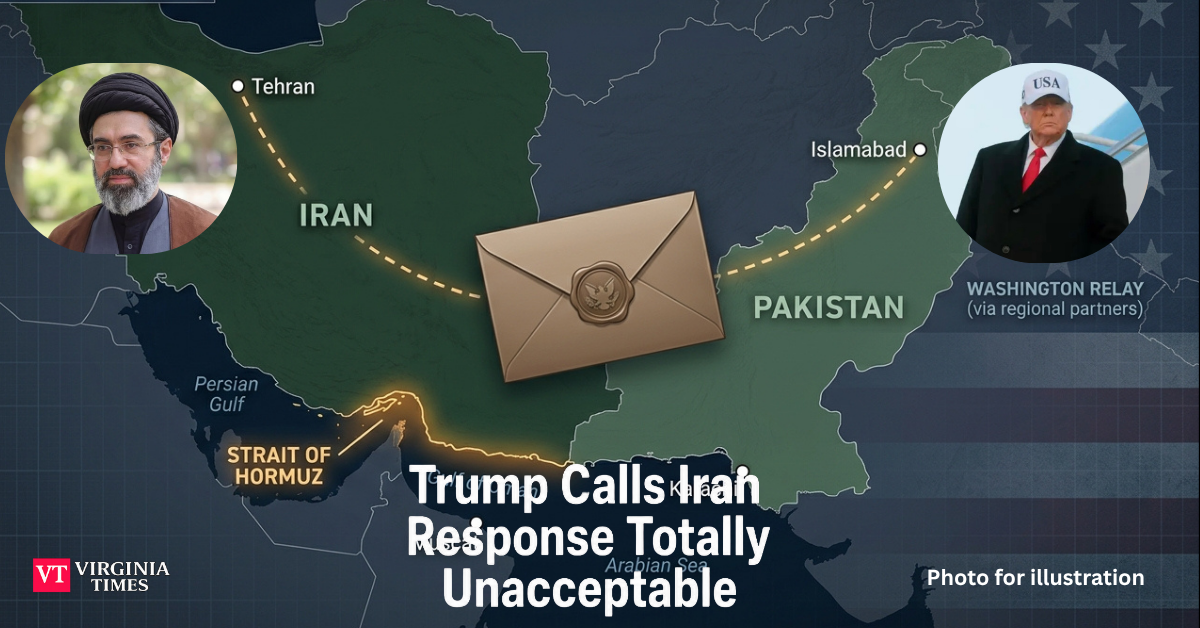
President Donald Trump rejected Iran’s response to the latest U.S. proposal aimed at ending the war, calling Tehran’s answer “TOTALLY UNACCEPTABLE.”
“I have just read the response from Iran’s so-called ‘Representatives.’ I don’t like it — TOTALLY UNACCEPTABLE!” Trump wrote on Truth Social on Sunday.
Iran had submitted its response through Pakistani mediators after the United States put forward a proposal intended to end the conflict and open a path toward talks on regional security and Iran’s nuclear program, according to IRNA, Iran’s state news agency.
Iranian state media said Tehran’s response focused first on ending hostilities in the region. The proposal came as tensions continued around the Strait of Hormuz, a critical route for global oil shipping.
Iran’s English-language state outlet Press TV has reported on Iranian efforts to regulate maritime traffic through the Strait of Hormuz, including a passage mechanism for vessels transiting the waterway. Reuters reported that Iran’s response addressed shipping safety but did not specify how or when the strait could be fully reopened.
The U.S. plan was reported to include ending the war, reopening the Strait of Hormuz and moving toward negotiations over Iran’s nuclear program. Al Jazeera reported that Washington had submitted a 14-point proposal through mediators.
Media reports said Iran’s response appeared to leave room for ending the war, holding nuclear negotiations and gradually reopening the Strait of Hormuz to commercial shipping if U.S. restrictions were lifted.
But Tehran reportedly pushed back against several major U.S. demands, including terms involving its nuclear facilities, highly enriched uranium stockpile and any long-term halt to uranium enrichment.
Iran’s reported counter-position also included calls for oil-related sanctions relief, the release of frozen funds and guarantees tied to any uranium transferred outside the country. Those details have been reported through media accounts and have not all been confirmed in full by official U.S. or Iranian statements.
The Wall Street Journal, citing people familiar with the response, reported that Iran proposed diluting some highly enriched uranium and sending the rest to a third country. Other reported terms said Tehran wanted to maintain control over the Strait of Hormuz while talks continued.
Iranian media also said Tehran wanted the current phase of negotiations to focus on ending hostilities across the region, including Lebanon.
Trump’s rejection of Iran’s response to the latest U.S. proposal leaves the diplomatic initiative uncertain. The U.S. has pressed for an agreement that would end the fighting, restore commercial shipping through the Strait of Hormuz and address Iran’s nuclear program.
Iran, meanwhile, is seeking sanctions relief and guarantees before making deeper concessions. The exchange marks another setback for mediation efforts as Washington and Tehran remain divided over the scope of any ceasefire, the future of Iran’s nuclear program and control of shipping through the Gulf.