
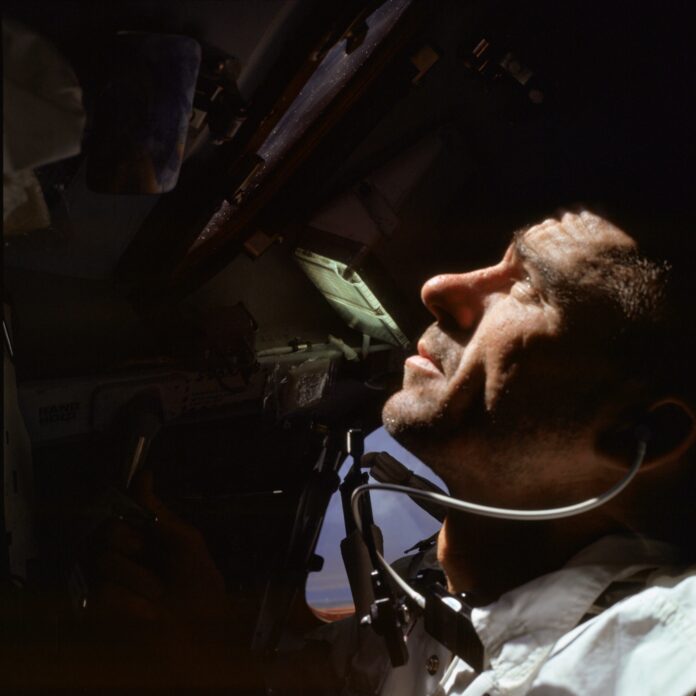
Former astronaut Walter Cunningham, who flew into space on Apollo 7, the first flight with crew in NASA’s Apollo Program, died early Tuesday morning in Houston, the US space agency announced on Tuesday. He was 90 years old.
Cunningham, whose 1968 Apollo 7 mission opened the way for the first human moon landing a few months later in 1969, died on Tuesday morning in Houston, a NASA statement said.
“Walt Cunningham was a fighter pilot, physicist, and an entrepreneur – but, above all, he was an explorer. On Apollo 7, the first launch of a crewed Apollo mission, Walt and his crewmates made history, paving the way for the Artemis Generation we see today,” said NASA Administrator Bill Nelson. “NASA will always remember his contributions to our nation’s space program and sends our condolences to the Cunningham family.”
Cunningham was born March 16, 1932, in Creston, Iowa. He graduated from Venice High School, in Venice, California, before going on to receive a Bachelor of Arts with honors in physics in 1960 and a Master of Arts with distinction in physics in 1961 from the University of California at Los Angeles. He then completed a doctorate in physics with exception of thesis at the Advanced Management Program in the Harvard Graduate School of Business in 1974.
The Cunningham family offered the following statement: “We would like to express our immense pride in the life that he lived, and our deep gratitude for the man that he was – a patriot, an explorer, pilot, astronaut, husband, brother, and father. The world has lost another true hero, and we will miss him dearly.”
He joined the Navy in 1951 and served on active duty with the U.S. Marine Corps, retiring with the rank of colonel. He flew 54 missions as a night fighter pilot in Korea. He worked as a scientist for the Rand Corporation for three years. While with Rand, he worked on classified defense studies and problems related to the Earth’s magnetosphere. Cunningham has accumulated more than 4,500 hours of flying time in 40 different aircraft, including more than 3,400 in jet aircraft.
Cunningham was selected as an astronaut in 1963 as part of NASA’s third astronaut class.
“On behalf of NASA’s Johnson Space Center, we are beholden to Walt’s service to our nation and dedication to the advancement of human space exploration,” said Vanessa Wyche, center director. “Walt’s accomplished legacy will continue to serve as an inspiration to us all.”
Prior to his assignment to the Apollo 7 crew, Cunningham was on the prime crew for Apollo 2 until it was cancelled and the backup lunar module pilot for Apollo 1.
Cunningham was designated the lunar module pilot for the 11-day flight of Apollo 7, which launched on Oct. 11, 1968 and was the first human flight test of the Apollo spacecraft. With Walter M. Schirra, Jr. and Donn F. Eisele, he tested maneuvers necessary for docking and lunar orbit rendezvous using the third stage of their Saturn IB launch vehicle. The crew successfully completed eight tests, igniting the service module engine, measuring the accuracy of performance of all spacecraft systems, and providing the first live television transmission of onboard crew activities. The 263-hour, 4.5-million-mile flight splashed down Oct. 22, 1968, in the Atlantic Ocean.
Cunningham’s last assignment at NASA Johnson was chief of the Skylab branch of the Flight Crew Directorate. In this capacity, he was responsible for the operational inputs for five major pieces of manned space hardware, two different launch vehicles and 56 major experiments that comprised the Skylab Program.
Cunningham retired from NASA in 1971 and would go on to lead multiple technical and financial organizations. He served in senior leadership roles with Century Development Corp., Hydrotech Development Company, and 3D International. Cunningham also was a longtime investor and entrepreneur, organizing small businesses and private investment firms. He also was a frequent keynote speaker and radio talk show host.
His numerous awards include the NASA Exceptional Service Medal and NASA Distinguished Service Medal. For his service he was inducted into the Astronaut Hall of Fame, International Space Hall of Fame, Iowa Aviation Hall of Fame, San Diego Air and Space Museum Hall of Fame, and Houston Hall of Fame. Cunningham and the Apollo 7 crew also earned an Emmy in the form of the National Academy of Television Arts and Sciences Special Trustee Award.