
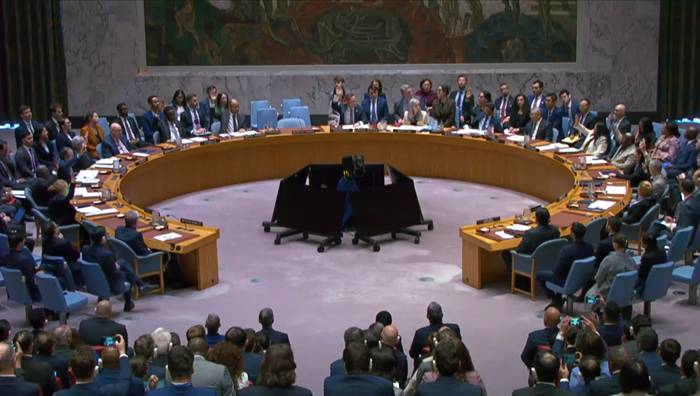
The U.N. Security Council on Wednesday adopted Resolution 2817 (2026), condemning what it described as Iran’s attacks on several Gulf countries and Jordan as the Middle East conflict entered its second week.
The measure passed 13-0, with China and the Russian Federation abstaining, according to a U.N. Security Council press release. The resolution condemned attacks against Bahrain, Kuwait, Oman, Qatar, Saudi Arabia, the United Arab Emirates and Jordan, and reiterated support for those countries’ sovereignty, territorial integrity and political independence.
The resolution also condemned attacks on residential areas and civilian objects and demanded that they stop immediately. It further called on Tehran to halt threats, provocations and actions aimed at interfering with maritime trade, as well as support for proxy groups across the region.
Bahrain’s representative, welcoming the vote, said the resolution showed broad international backing against what he called unjust and hostile acts targeting sovereign countries. He said nearly 140 U.N. Member States co-sponsored the text, calling that support a sign of the world’s “collective conscience.”
Several Council members said the conflict was becoming more dangerous by the day. Denmark’s representative condemned Iran’s attacks and called for restraint, civilian protection and respect for international law. France’s representative said the war posed grave risks to regional security and argued that only diplomacy and respect for international law could bring lasting stability.
The press release said the war began with Israeli and U.S. airstrikes on Iran on Feb. 28 and has since spread to nearly a dozen countries in the region. China, explaining its abstention, said the United States and Israel launched military strikes without Security Council authorization and argued that the adopted resolution did not present the full picture of the conflict in a balanced way.
Russia strongly criticized the Council-backed text and introduced a second draft resolution that it described as an impartial effort to urgently de-escalate the crisis. Moscow’s representative said the adopted measure was biased and ignored the wider context of the war, including civilian deaths in Iran.
The Russian draft was later rejected by the Council in a 4-2 vote, with nine abstentions. China, Pakistan, Russia and Somalia voted in favor, while Latvia and the United States voted against it.
After the vote, Bahrain said it abstained on Russia’s draft because it did not reflect the scale of the military escalation now gripping the region. France also abstained, saying the Russian text failed to address what it described as Iran’s responsibility for the current escalation.
Israel and Iran also addressed the Council. Israel welcomed the resolution and said the message was clear that targeting civilians and cities must stop. Iran’s representative called the vote a serious setback to the Council’s credibility and described the resolution as a manifest injustice against his country.
The vote leaves the Council sharply divided over how to frame the conflict, even as members warned that the widening violence risks further destabilizing an already fragile region.

A global media for the latest news, entertainment, music fashion, and more.