

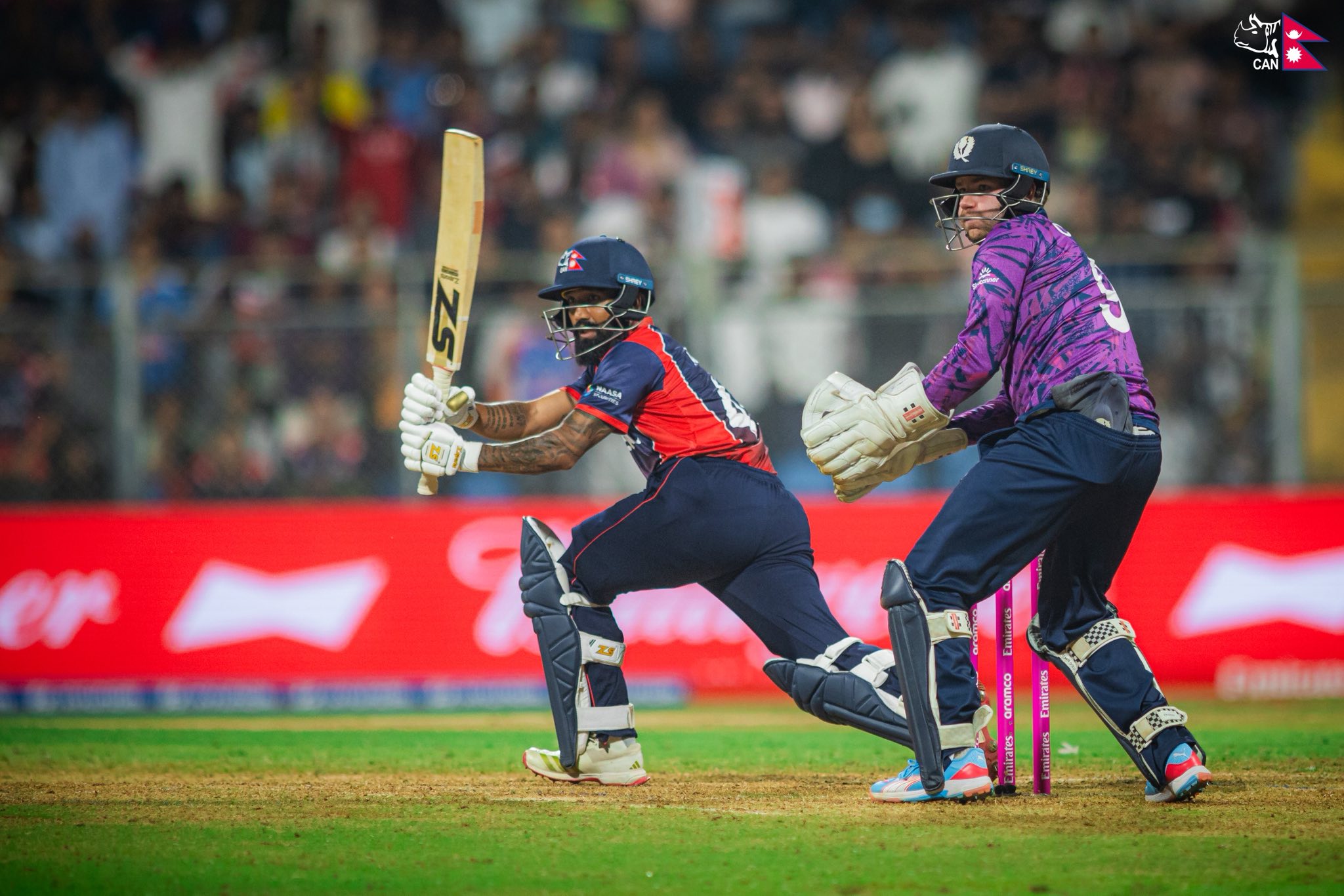
The numbers told one story, while the moment told an entirely different tale.
When Dipendra Singh Airee dispatched one to the stands in Mumbai to score his half-century in just 23 balls, it was not just about him reaching the milestone. It was about Nepal breathing a sigh of relief after 12 long years. They had won a match in the T20 World Cup once again. And they had done it in style at the legendary Wankhede Stadium in Mumbai, which had witnessed some of the greatest matches in cricket history.
There is always that extra pressure in matches that don’t really mean anything. The dream of reaching the Super 8 was already dead and buried after England, Italy, and the West Indies ensured that Nepal’s chances of reaching the knockouts were nothing more than a distant dream. Nepal knew they had to win against Scotland to stay in the competition. But there was no way they could reach the Super 8 from this match.
So, they decided to bowl first after winning the toss. And from the very first over, there was a new Nepal that was determined to win. Scotland, on the other hand, was on fire from the very first ball. Michael Jones looked like he was in control at the top of the order. And with Munsey by his side, they started to build an innings that could potentially trouble Nepal. By the end of the 10th over, they had scored 80/1 with the asking rate under control.
But that was when Nepal decided to wake up. Rohit Paudel intervened in the 10th over to dismiss Munsey and turn the tables in Nepal’s favor. The last ten overs of the Scottish innings looked like a siege for the Scottish batsmen. Nepal took six wickets to restrict Scotland to 170/7.
The turning point arrived in the shape of Sompal Kami, who took control of the death overs—the brutal and unforgiving end of a T20 match where careers are made or broken in the span of one ball. Sompal Kami was surgical in his attack. In the 16th over, he bowled Michael Jones clean off his stumps. The top-scorer’s 71 was brought to a disastrous end. A caught and bowled off McMullen followed in quick succession. By the 19th over, when he took his third wicket by dismissing Tom Bruce, Sompal Kami had achieved something special: with nine wickets in nine matches in this tournament, he had become Nepal’s all-time leading wicket-taker in the T20 World Cup.
Nepal’s chase got off to a start that reflected their nervousness and fluency. Openers Kushal Bhurtel and Aasif Sheikh set the tone for their chase from the very first ball. By the end of the powerplay, they had accumulated 56 runs—Nepal’s highest powerplay score in this tournament so far. It felt different. It felt fearless.
The partnership was worth 74 runs when Nepal’s opener Kushal Bhurtel fell to Michael Leask’s clever off-spin in the 13th over. Leask would strike again in his next over, removing Aasif for 33 and Rohit Paudel for 16. Nepal were suddenly 98 for 3. The ghosts of past collapses were back in a flash.
And then, Dipendra walked in.
What followed was the innings that redefined the player. Confronted by Leask in the 16th over, the same bowler who had dismissed Nepal’s chase, Dipendra didn’t show the slightest signs of hesitation. He dispatched two sixes and a four in the over, collecting 20 runs for Nepal, including the much-needed breakthrough. His half-century came in 23 balls, the result of some clean striking and aggression. And when the crowd realized the significance of this achievement—back-to-back fifties in the World Cup, the first Nepali player to do so—there was more at stake than mere cricket in this moment.
Gulshan Jha, promoted to No. 5, played with maturity beyond his age, scoring 24 not out, but the duo sealed the deal with four balls to spare.
The chase was for 171, which Nepal achieved in 19.2 overs, losing only three wickets. The numbers on the scorecard tell the story, but the context gives it meaning.
The scorcard was clean. The context was everything.
This result doesn’t turn the tables for Nepal in the tournament. They’re already out. However, it does rewrite the script for them to leave the tournament. After six successive World Cup defeats over a decade, through the ups and downs of the tournament, the triumphs and the agonizing decisions, the Nepalis can leave with their heads held high and a performance that confirms the obvious: this team can sparkle when the stars align.
The Super Eight might have to wait. However, on a February evening under the lights at the Wankhede, in lights that have witnessed cricket’s finest moments, the Nepalis have written a new chapter in their history.
The wait has been a long one: a dozen years. The wait is now over.

A global media for the latest news, entertainment, music fashion, and more.