

KATHMANDU, Nepal — Nepal’s National Statistics Office has published the country’s first National Transfer Accounts (NTA) report, mapping how people’s labor income, consumption and resource flows shift across the life cycle.
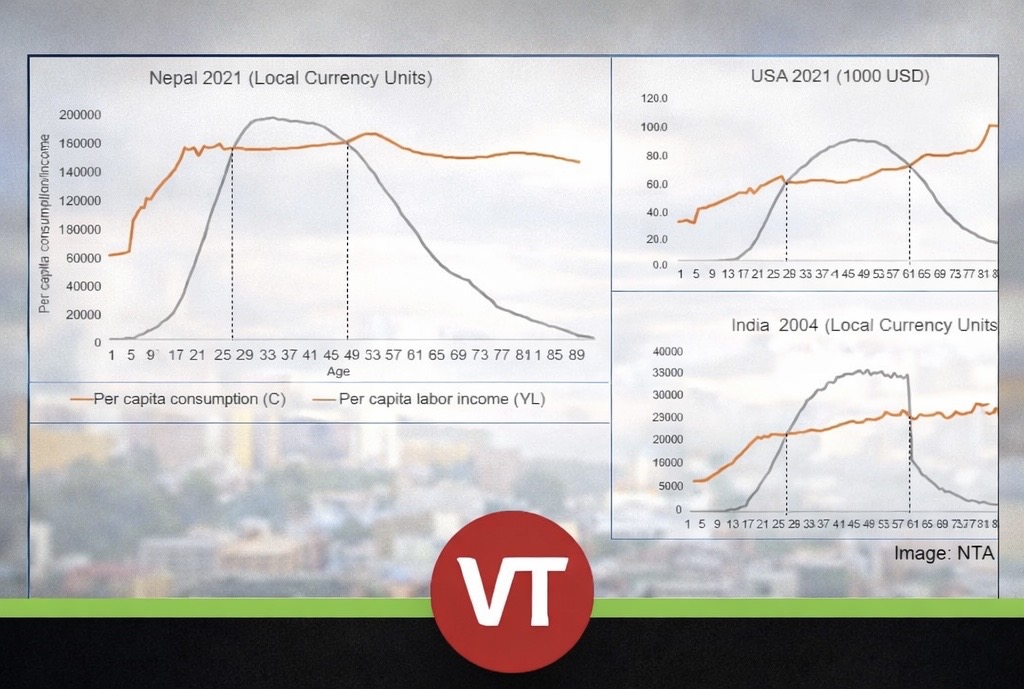
While the rest of the population tends to spend more than it earns, Nepal’s working-age group, roughly between the ages 27 and 46, brings in more than it spends, NSO said.
The report, prepared with the fiscal year 2078/79 (2021/22) as the base year, finds that Nepal shows a “lifecycle surplus” only for a narrow span of working ages. Labor income exceeds consumption from ages 27 to 46, while consumption is higher than labor income for people younger than 27 and older than 46, creating a lifecycle deficit outside the surplus years, the office said.
Key observations develop along a life-cycle pattern: the under-27 population and over-46 populations exhibit a consumption deficit, indicating they must rely on transfers from within the household or public programs, or use savings to supplement their consumption. Contrasting that, the 27–46-year-old population exhibits a life-cycle surplus, wherein labor income is greater than consumption, reflecting the country’s most productive years, NSO said.
Per capita labor income in Nepal reaches a peak in the early 40s, while consumption remains relatively flat across ages. The period of surplus is shorter for Nepal compared to other countries-roughly 20 years-compared to 33 years in the U.S. and 34 years in India, NSO said.
The estimated total life-cycle deficit stands at approximately NPR 1.53 trillion for FY 2078/79, NSO said. Around 65 percent of the Nepalese population falls within the 15–64 working-age bracket, yet the labor force participation rate is just 38.5 percent, while the unemployment rate among the young stands at 12.7 percent, NSO said. It also links the increasing disparity between income and consumption to a lack of job opportunities and inequalities in skill availability, NSO said.
The Finance Minister, Rameshwar Prasad Khanal, speaking at the report launch in Kathmandu, said that it would help evidence-based policy planning in the areas of social security, education, and employment. “We cannot make good policies without data,” he underscored, while urging for credible research led by the government to inform stronger decision-making.
The NTA report, developed with technical assistance from UNFPA, also indicated that per capita public health expenditure far outstripped private expenditure, emphasizing the central role of government in health investment, NSO said.
According to NSO officials, the report will allow long-term fiscal planning and shape future social protection, education, and labor programs in a way that will increasingly tap into Nepal’s demographic potential.

A global media for the latest news, entertainment, music fashion, and more.