

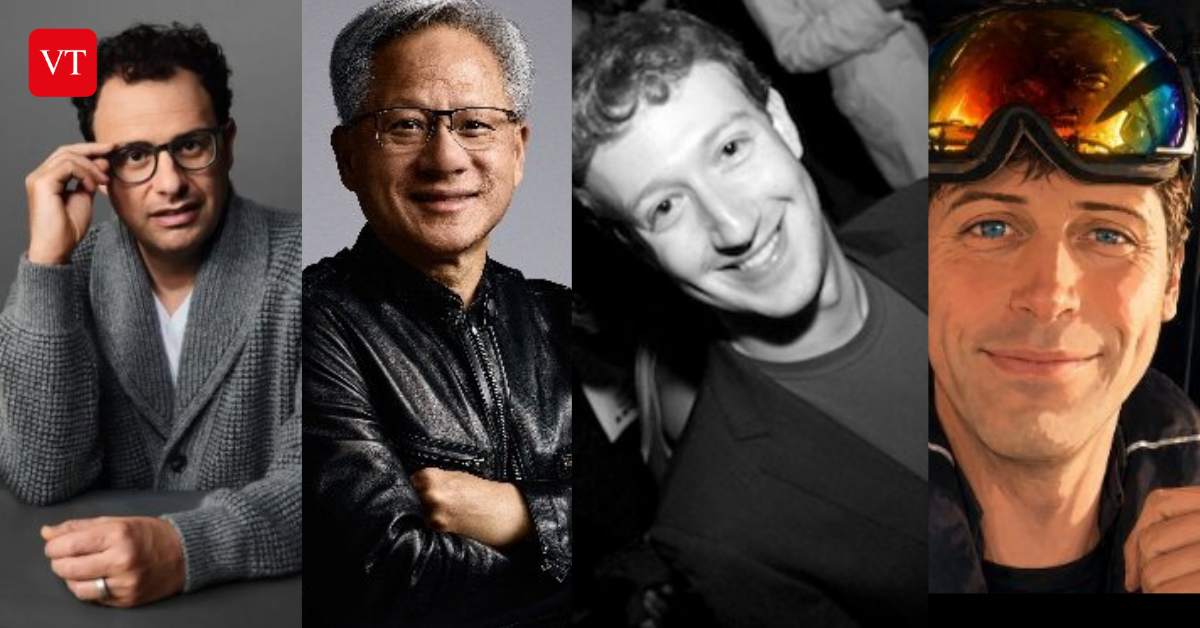
Nvidia CEO Jensen Huang and Meta CEO Mark Zuckerberg rejected calls for a coordinated slowdown in frontier AI development, arguing that individual companies should manage their own safety risks.
Their positions contrast with Anthropic CEO Dario Amodei’s call to pace advances in frontier-model capabilities so that safety work can keep up. Amodei said pacing would not stop model training or technical progress.
At Salesforce’s Dreamforce conference Tuesday in San Francisco, Huang argued that market pressure and corporate responsibility could keep unsafe AI products from reaching customers. He rejected the need for additional U.S. AI safety laws or regulations.
Companies should release products only when they are confident in their performance, capabilities and safety, Huang said. He also rejected the idea that developers must choose between rapid innovation and safe products.
Under Huang’s approach, developers could advance quickly while retaining control of their systems. A company should pause and correct its work if development moves beyond its control or a product appears unsafe, he said.
Meta CEO Mark Zuckerberg made a similar argument Tuesday on X.
“Every lab has the responsibility and incentive to move at the pace required to train its models safely, and the ability to take its own actions to ensure that happens.”
People will avoid agents that fail to follow their instructions, according to the post, giving developers a commercial reason to improve alignment. Zuckerberg said trust and alignment would increasingly distinguish competing models and agents.
He also argued that laboratories could face significant liability if their models caused harm. He presented potential liability as another reason for laboratories to prevent harmful behavior.
Meta delayed its Muse AI agent for several months to strengthen safety and security, Zuckerberg wrote. The company acted independently rather than asking competitors to delay their products first.
Zuckerberg supported using independent evaluators and advisers, saying Meta Superintelligence Labs already works with them in several areas. He called for a larger and more diverse evaluator ecosystem.
His post did not expressly support Anthropic’s proposal to provide evaluators with permanent, employee-level access to internal systems.
Zuckerberg also said Meta has committed most of its computing capacity to serving users rather than racing toward recursive self-improvement. Other laboratories could make the same commitment, he wrote.
Amodei Proposes Three-Part Framework
In his essay, Amodei proposed three levels of action for increasingly capable AI.
First, frontier companies would give independent evaluators continuing, employee-like access to verify safety practices, examine incidents and assess models during development. Anthropic committed to that step.
Second, companies in democratic countries would coordinate on safety standards and limits on unchecked advances. Amodei said some cooperation would require government support or a narrow antitrust waiver.
Third, governments would pursue wider international coordination, including possible agreements with authoritarian countries. Amodei acknowledged that compliance would be difficult to verify.
OpenAI CEO Sam Altman endorsed the call and said OpenAI would match Anthropic’s commitment on independent evaluators. Elon Musk offered a brief endorsement of Amodei’s position.
Google DeepMind CEO Demis Hassabis said the proposal pointed in the right direction but needed further work. He connected it to Google DeepMind’s proposal for an industrywide standards body.
Microsoft CEO Satya Nadella welcomed deliberate pacing intended to improve alignment and supported considering embedded evaluators. Nadella said oversight should include broad representation across companies, countries, academic fields and the wider ecosystem.
The executives offered different levels of support, but their statements did not establish a binding industrywide agreement.
Debate Extends to Model Access
The disagreement overlaps with divisions over open-weight and closed-weight AI systems.
Anthropic’s frontier models and OpenAI’s principal frontier systems restrict access to their underlying weights, although OpenAI also offers some open-weight models. Meta and Nvidia promote systems whose weights can be downloaded, modified and run on private infrastructure.
Some open-weight supporters argue that restrictive safety requirements could give companies controlling closed systems a competitive advantage.
Nvidia is a leading supplier of accelerators used to train and operate advanced AI. It also has substantial commercial and financial connections with OpenAI, Anthropic and Musk’s SpaceXAI business.
Trump Joins Slowdown Debate
The dispute reached the All-In Summit in Los Angeles on Monday, when President Donald Trump called Huang while the Nvidia chief was onstage.
Trump dismissed fears of an AI takeover and criticized efforts to slow U.S. AI development and data-center construction. He argued that restrictions could benefit China, while also saying development should proceed carefully.
Huang agreed that the industry should not be stopped. The exchange underscored the widening disagreement over whether AI safety should depend on individual companies or coordinated standards.
Editor’s Note: AI assisted with research, organization and initial drafting. Virginia Times verified the information and is responsible for the final story.

A global media for the latest news, entertainment, music fashion, and more.