

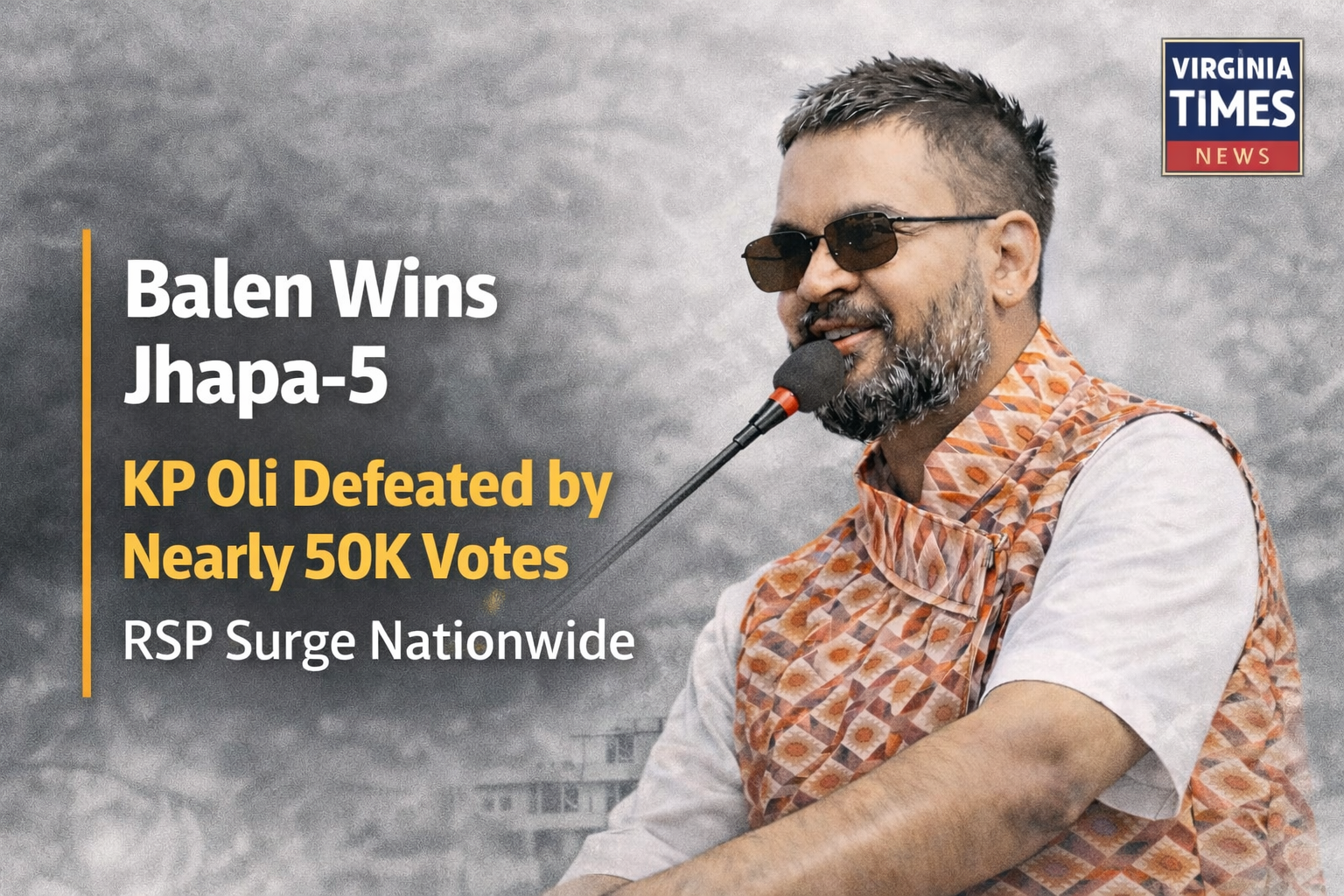
Balendra Shah, also known as Balen, has scored the biggest headline victory in Nepal’s election history, defeating former prime minister and CPN-UML chairman KP Sharma Oli in Jhapa-5 by a massive margin of 49,614 votes. Shah secured 68,348 votes, while Oli was held to 18,734, in a result that has quickly become the defining symbol of a wider political shift unfolding across the country.
Politics often makes history when a bold move is undertaken, when someone takes a courageous detour from the conventional script, when someone takes a risk and chooses the unconventional over the carefully calculated and conventional. Well, 36-year-old Balen Shah, a civil engineer, former rapper and former mayor of Nepal’s capital, has just made such a move. When Shah announced he would contest from a constituency considered Oli’s stronghold, many saw it as politically reckless.
Yet the results have defied all expectations. Shah has not only challenged Oli, but has also outperformed him by a huge margin in what has traditionally been considered a UML bastion. What once looked like a gamble is now being hailed as a historic milestone in Nepal’s democratic journey.
Shah’s path to power has been unconventional from the start. Born in Gaurigaun, Kathmandu, to Dr. Ram Narayan Shah and Dhruvadevi Shah, he studied civil engineering at White House Institute of Technology and later earned a master’s degree in structural engineering in India. He has said his work took him across 65 districts of Nepal, giving him an experience base few politicians can claim. Until a few years ago, though, Shah was perhaps better known among young Nepalis as a rapper.
He entered politics in 2022 as an independent candidate for Kathmandu mayor and won. Much of the country had underestimated his chances at the time, according to analysts and media reports. But that victory was widely seen as a sign of something larger: a shift in Nepal’s politics and in voter loyalties, especially among younger people disillusioned with politics as usual.
Now, that shift appears to have expanded from city politics into national power. As of 9:30 p.m. local time on Saturday, March 7, the Rastriya Swatantra Party had already won 74 direct seats and was leading in 48 more constituencies. In the proportional vote tally shown in the latest public count snapshot, RSP was also far ahead with 446,350 votes. Nepali Congress stood at 150,410, CPN-UML at 120,788, and NCP at 61,959.
The party-wise direct tally visible in the latest count showed Nepali Congress with 11 wins and 9 leads, CPN-UML with 4 wins and 7 leads, NCP with 3 wins and 4 leads, RPP with 1 win, and one independent win. Smaller parties remained well behind. If those trends broadly hold through the final count, RSP would be positioned to dominate the 165 direct seats and capture the biggest share of the 110 proportional seats in Nepal’s 275-member House of Representatives.
A two-thirds majority in the full chamber would require 184 seats. Final certification is still pending, but the election has already triggered serious discussion over whether RSP could secure not just a simple majority, but a mandate large enough to reshape the political order in Kathmandu.
Balen’s victory has become central to that discussion. So has the party’s earlier political messaging. RSP had already projected him as its prime ministerial face after he joined the party under a seven-point agreement. With Shah now winning Jhapa-5 in stunning fashion, and RSP chair Rabi Lamichhane also winning Chitwan-2 with 54,402 votes, that earlier framing no longer looks symbolic. It now sits at the heart of Nepal’s government formation debate.
The broader list of candidates crossing the 50,000-vote mark adds to that story. Along with Balen Shah’s 68,348 votes in Jhapa-5, Sovita Gautam won 59,277 in Chitwan-3, Dr. Lekhjung Thapa secured 58,814 in Rupandehi-3, Sulav Kharel took 56,550 in Rupandehi-2, Rubina Acharya won 55,513 in Morang-6, Rabi Lamichhane got 54,402 in Chitwan-2, and Badan Kumar Bhandari won 53,344 in Kavre-2.
Those results suggest RSP’s momentum is not confined to one city, one district or one personality. The party’s strongest performances are spread across multiple constituencies, showing a broader national reach than many expected. The old parties are still present, but this election is increasingly looking like a turning point shaped by voter anger, generational change and a growing appetite for a different kind of leadership.

A global media for the latest news, entertainment, music fashion, and more.