











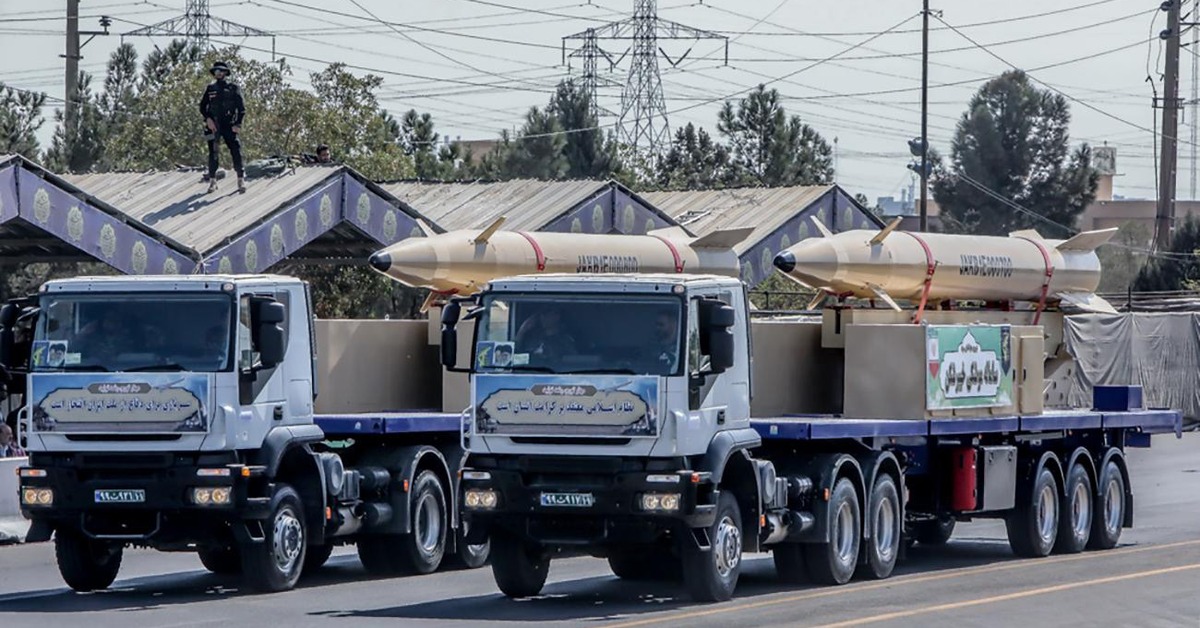
WASHINGTON — Iran still has between 1,500 and 2,500 missiles, the U.S. intelligence community assesses, according to The Wall Street Journal. If all-out war resumes, Tehran could still strike U.S. and allied targets, officials said.
That figure came with a candid label: a low-confidence assessment. The exact number of missiles Iran could launch, and the exact number sitting in storage, were not known. Set the uncertainty aside, though, and officials said one point was clear — the stockpile Tehran kept is a formidable one.
The United States and Israel damaged Iran’s missile production facilities. Tehran went on rebuilding anyway, though more slowly than before the war, and mostly from components it had already stockpiled, officials said. Drones are plentiful too, along with short-range missiles.
Israeli military officials put the figure in a similar place. Their assessment is that Iran holds more than 1,500 ballistic missiles, though officials elsewhere in the region give varying numbers because pinning down an exact count is so difficult.
Simone Ledeen saw weight in even the lowest figure. Ledeen, who served as deputy assistant secretary of defense for the Middle East in President Donald Trump’s first term, said 1,500 missiles would mean Iran had replenished more than half of its estimated prewar stockpile. She added that Iran had fully rebuilt its arsenal between the 12-day war in June 2025 and the start of the current conflict in February.
A Stockpile That Cuts Against Victory Claims
That rebuilt arsenal stands uncomfortably beside the administration’s own statements. Trump and other officials have called Iran’s military decimated. Inside the administration, the Journal reported, the assessment has become part of a live argument: should Washington join Israel in striking again, or not?
Destroying Iran’s ballistic missile capability was one reason the United States and Israel launched the war. Both declared success after the joint bombing campaign, with Prime Minister Benjamin Netanyahu claiming the missile program had been crushed and the remaining missiles were “running dry.” An Israeli military official put it differently now: badly hit, Iran is “rebuilding, rearming” and preparing for a serious round of fighting.
Iran, for its part, kept doing damage. It used ballistic missiles, drones and better tactics against U.S. installations, radars and early-warning systems across the Middle East, officials said. Many American military assets were moved to Israel as a result, a place U.S. and Israeli officials consider safer.
Trump has held off on ordering large-scale strikes for now, the Journal reported. He has kept the pressure on through a blockade and sanctions instead. Vice President JD Vance used the pause in fighting to open a channel to an Iranian hard-liner in search of a deal, but Trump told him to end that diplomacy and focus on domestic issues.
America’s Gulf allies do not want the war to start again. They have told the administration that Iran could answer with missiles and drones aimed at them. Netanyahu, who is serving as caretaker prime minister after inconclusive elections last month, is pushing the other way, for renewed operations in Iran. Mossad Director Roman Gofman was in Washington on Friday to discuss Iran with U.S. officials.
What Trump and Hegseth Said This Week
Trump himself gave a more qualified account on Wednesday. Speaking in a Veterans Day address, he suggested the United States had not entirely defeated Iran. “We won,” he said. “Now the question is when we want to end. We must have a total victory, not a 93% victory. It’s going to be total.” Later, he told radio host Hugh Hewitt it would be a “defeat” for the United States if the Iranian regime were still in power at the end of his term.
A White House official offered a harder line. Operation Epic Fury, the American name for the campaign against Iran, had rendered Iranian forces helpless, the official said, and economic strangulation had made the regime weaker than ever.
Defense Secretary Pete Hegseth sounded just as certain on Tuesday, at his first press conference in six months. Iran’s defense-industrial base was “gone,” he told reporters, along with more than 80% of its nuclear-industrial base. “By every measure we achieved a historic military victory,” he said.
Why the Count Is So Hard to Fix
Jim Lamson knows that difficulty firsthand. He now sits at King’s College London as a visiting research fellow. Before academia, the work was at the CIA, where Iran’s military was his beat. The numbers, he noted, are closely guarded in Tehran, production is spread across many different producers, and nobody can say how many new missiles could be put together from finished parts that already sit underground. Prewar estimates were murky too, he said. “Having done this work for the government, I know it can be extremely low confidence even with all the classified information,” he said.
Earlier reporting by the Journal traced how some of the arsenal survived. The Journal followed the trail underground in April. Thousands of short- and medium-range ballistic missiles, it reported, were still within Iran’s reach, stored below ground. Israeli and U.S. strikes had caved in the entrances. Satellite pictures later caught Iran digging some entrances back open. The missiles inside, an Israeli official said, had in all likelihood survived without damage. In September, the Journal reported that Iran had resumed producing ballistic missiles from those finished, stockpiled components.
Tehran raised the stakes on range this month as well. Its Revolutionary Guards said the restriction on the range of the country’s missiles has been lifted, a claim Virginia Times reported on Nov. 7 without evidence of a longer-range missile being tested or fielded.
Bilal Saab argued the numbers are only half the story. Iran’s attacks, Saab said, land better than they used to. Its intelligence is sharper, its targeting data has improved — help from allies such as Russia played a part — and its commanders now mix drones in with missiles instead of firing missiles alone. Saab is senior managing director of Trends US, a geopolitical risk firm based in Washington. “It’s not just the size of that arsenal. It’s how Iran uses it, and its commanders have learned a few tricks to be more effective,” he said.