

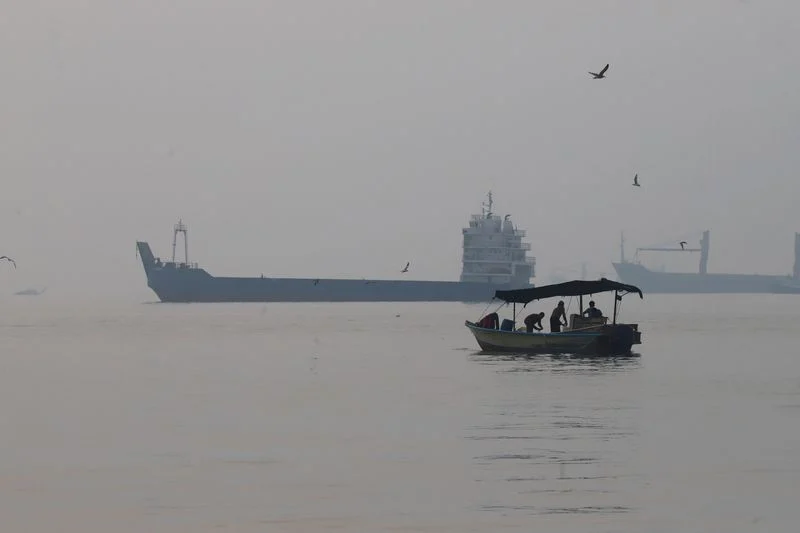
A chemical tanker was struck by multiple projectiles north of Qatar on Wednesday, causing a fire and reported casualties. Earlier that day, an Iranian Revolutionary Guards adviser warned that Tehran would close shipping routes through the Strait of Hormuz it considers illegal.
The Royal Navy-led UK Maritime Trade Operations Centre said the attack occurred at about 1900 UTC on Oct. 7, approximately 51 nautical miles north of Madinat ash Shamal, Qatar, according to Riviera Maritime Media.
Maritime security firm Vanguard Tech identified the vessel as the Acers, an Antigua and Barbuda-flagged tanker. Ambrey, another security firm, reported “multiple casualties” but did not give a number or describe their condition.
Ambrey said the crew extinguished the fire and the tanker began sailing toward Kuwait under its own power. The extent of the damage had not been disclosed.
Tracking data showed the Acers had entered the Gulf through the U.S.-designated southern route of Hormuz on the night of Oct. 3–4, Ambrey said. Its account did not establish whether that transit was connected to Wednesday’s attack.
Greece-based maritime consultancy Marisks said three drones struck the tanker while it was drifting. UKMTO described the weapons as projectiles. Responsibility for the strike has not been confirmed.
Iran threatens alternative routes
Mohammadreza Naqdi, an adviser to the Revolutionary Guards’ commander, told the semi-official Fars News Agency on Wednesday that routes along Oman’s coast would soon be closed, Reuters reported.
Naqdi alleged that the passages had been created by blasting rocky sections of the waterway and that small boats used them to smuggle oil to tankers. He also claimed Iran controlled the strait and would keep it closed until Tehran’s demands were met.
The Acers was attacked inside the Gulf, outside Hormuz. EOS Risk Group’s head of advisory, Martin Kelly, told Riviera the strike came nearly a month after the previous suspected Iranian attacks on commercial vessels outside the strait.
A separate report concerned a possible vessel fire about 30–32 nautical miles east of Fujairah, in the Gulf of Oman. Riviera said maritime security reporting and NASA’s fire-detection system showed a heat signature consistent with a fire.
Marisks reported a suspected projectile strike in that area. The vessel’s identity, the circumstances of the apparent fire and any casualties remained unconfirmed.
Attacks rise and tanker traffic falls
Maritime security sources cited by Reuters counted at least 12 attacks on oil and gas tankers around Hormuz between Sept. 28 and Oct. 5, Riviera reported. The sources said it was the highest weekly total since the war began in late February.
Among the vessels reportedly struck was the Greek-flagged LNG carrier Maran Gas Mystras. Vanguard Tech reported an engine-room fire, while the operator said the vessel remained operational and its crew was safe, according to Riviera.
Ambrey reported that 12 of the Panama-flagged tanker On Peace’s 19 crew members were injured in another attack, including 11 Indian nationals. Omani authorities helped evacuate the injured sailors to Khasab.
Preliminary Kpler data cited by Riviera showed oil moving through Hormuz averaged about 9 million barrels a day over the seven days through Oct. 3, compared with a prewar baseline of 17.1 million.
Tanker crossings averaged about 13 a day, down from roughly 50 before the war. Kpler recorded seven vessel transits on Oct. 6.
CENTCOM reports blockade operations
The United States is separately enforcing a blockade against ships entering or leaving Iranian ports.
In its official Oct. 5 release, U.S. Central Command said its forces had redirected the 130th commercial vessel since resuming the blockade July 14.
CENTCOM said American forces had disabled three ships that refused to comply. It also said its forces had destroyed 13 commercial vessels over the preceding 12 weeks, describing them as blockade violators or part of the Revolutionary Guards’ shipping network.
“We will swiftly act against any vessels trying to run the blockade,” CENTCOM commander Adm. Brad Cooper said.