

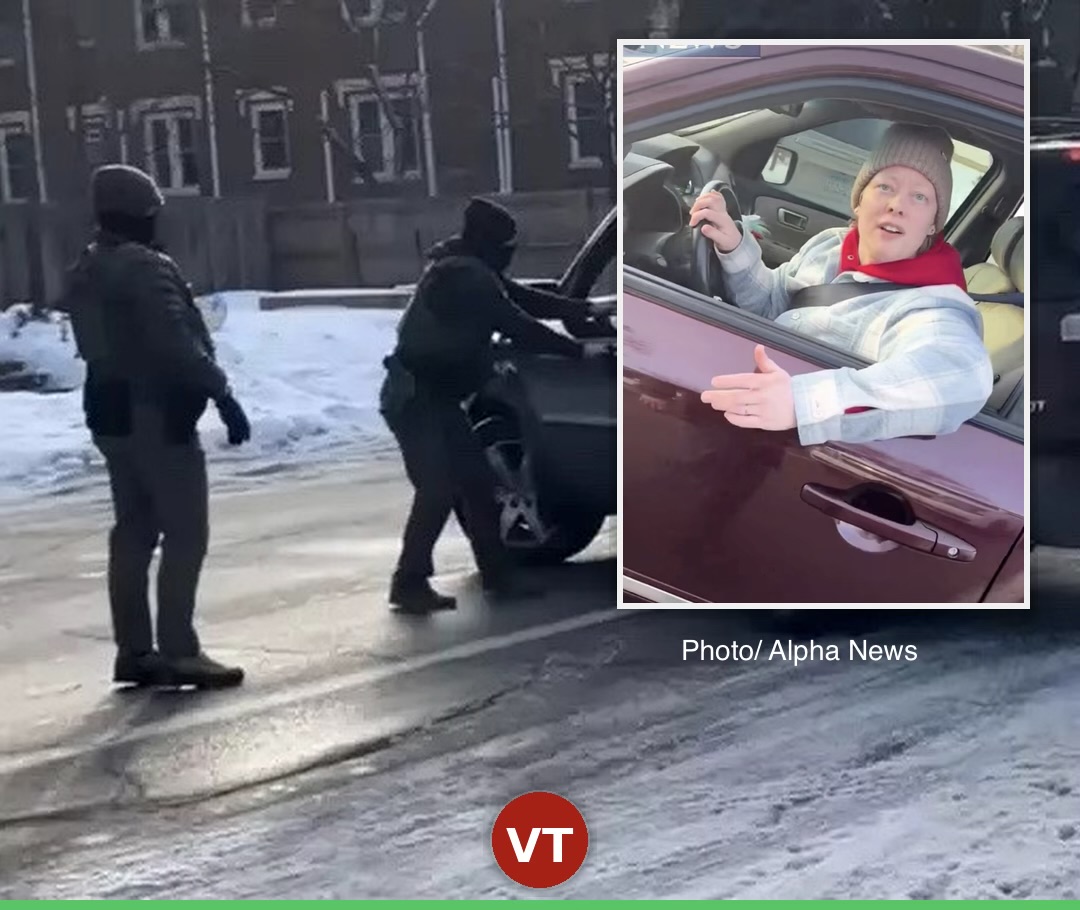
A new YouTube breakdown by forensic psychologist Dr. John Paul Garrison is adding fuel to the national argument over whether Renee Nicole Good was trying to flee — or threaten — in the seconds before an ICE agent shot her to death in Minneapolis.
In the video posted on Dr. G Explains, Garrison says visible vehicle cues in the footage — including reverse lights, the brake light, and steering-wheel movement — point to “flight” behavior that he believes is more consistent with an attempt to leave than an attempt to ram an agent. He repeatedly describes his analysis as opinion and says it is not a formal psychological evaluation.
His claims intersect with what outside video analysts have documented about the timeline. A frame-by-frame reconstruction by ABC News reported that three shots can be heard, with 399 milliseconds between the first and second. ABC also reported that in the verified footage, Good can be seen turning her steering wheel to the right — away from the agent — just over one second before the first shot, even as the vehicle briefly moves forward before veering.
Background of the case
Renee Nicole Good, 37, was shot on Jan. 7 during a federal immigration enforcement operation in south Minneapolis, a confrontation that has drawn protests and competing political narratives about what happened in a narrow window of seconds.
Homeland Security officials have defended the shooting publicly. In a statement posted by the Department of Homeland Security, the agency described Good as a “violent” anti-ICE rioter who “weaponized” her vehicle and called the incident an act of “domestic terrorism,” saying an officer acted in self-defense.
President Donald Trump also weighed in online, writing on Truth Social that Good “violently, willfully, and viciously” ran over an ICE officer and that the shooting appeared to be self-defense, according to multiple reports; the platform is referenced as Truth Social.
Minnesota leaders have disputed the federal account. Minneapolis Mayor Jacob Frey rejected the self-defense characterization and called for an investigation, as reported by Reuters.
What the video shows, and what Dr. G argues it means
Garrison’s analysis focuses on the mechanics of the vehicle and how people behave under acute stress. He points to what he describes as Good turning the wheel left early, with the tires angled left, and says reverse lights appear illuminated while the brake light remains on — which he interprets as the vehicle already positioned to back out. He argues those cues suggest preparation to leave before the confrontation fully escalated.
He also contrasts Good’s demeanor with her wife’s, describing Good as comparatively calm, tracking the agent visually and speaking in a tone he associates with compliance, while her wife is shown moving closer and speaking more aggressively. Garrison suggests the agent filming may have focused more on the wife as the immediate challenge — a detail he believes matters when assessing what the agent expected from Good moments later.
As the encounter intensifies, Garrison highlights a moment where Good reverses while her wife is pulling on the locked door handle. He presents that as a sign of narrowed awareness, arguing that adrenaline and confusion can produce tunnel vision in “fight-or-flight” situations.
His central point is that “intent” and “perception” can diverge in a fraction of a second. Garrison argues that when Good shifts from reverse into forward motion, she starts turning the wheel right, but the tires may momentarily align straight ahead before the turn fully takes effect. In his telling, that brief forward track could look like a direct threat to an agent standing near the vehicle even if the driver’s goal was to steer away and escape.
ABC’s frame-by-frame timeline similarly describes the sequence as reverse movement followed by forward motion and a turn, noting that the wheels begin turning right as the vehicle starts moving forward. ABC reported that the video does not cleanly resolve whether the vehicle struck the agent, even as officials said the agent was hit.
Use-of-force standards now under a microscope
The dispute over what the driver “meant” to do is inseparable from the legal standard officers are trained to apply in real time: whether there is an imminent threat of death or serious bodily injury.
DHS policy lays out that deadly force is permitted only under strict imminent-threat conditions. The agency’s guidance is described in the publicly posted DHS Use of Force Policy.
The agent’s background and the reaction-speed question
Garrison also argues that an officer’s prior experiences can shape threat perception in vehicle encounters. He cites an earlier incident involving agent Jonathan Ross — the shooter — in which Ross was dragged by a vehicle during an arrest attempt in 2025, suggesting that such an event could prime faster fear-based reactions later.
Ross’s prior injury has been reported as a matter of record. The Associated Press reported that Ross is an Iraq War veteran who has served for nearly two decades in Border Patrol and ICE, and that he was seriously injured last summer after being dragged by a fleeing suspect’s vehicle.
Congressional outrage and the “glove compartment” claim
The political fallout has expanded beyond Minnesota. At a House Judiciary Committee hearing, Rep. Eric Swalwell referenced images he said showed Good’s glove compartment contained stuffed animals rather than weapons, using the point to argue she was being wrongly branded as a terrorist. Swalwell has shared that claim publicly in video, including a post from Rep. Eric Swalwell.
What happens next
Federal and local scrutiny is now focused on a tight set of questions: the precise vehicle path, the timing of commands and movement, whether there was contact with the agent, and how those facts match policy standards for deadly force.
Garrison’s video does not settle those questions. What it does is sharpen the argument over interpretation: whether the visible cues support an escape narrative, an imminent-threat narrative, or both — depending on where the officer stood and what he believed in the instant he fired.
Watch Video :